

Guest Article by Jean LaMantia, Registered Dietitian
Did you know your Lymphatic System is an essential component of your small intestines?
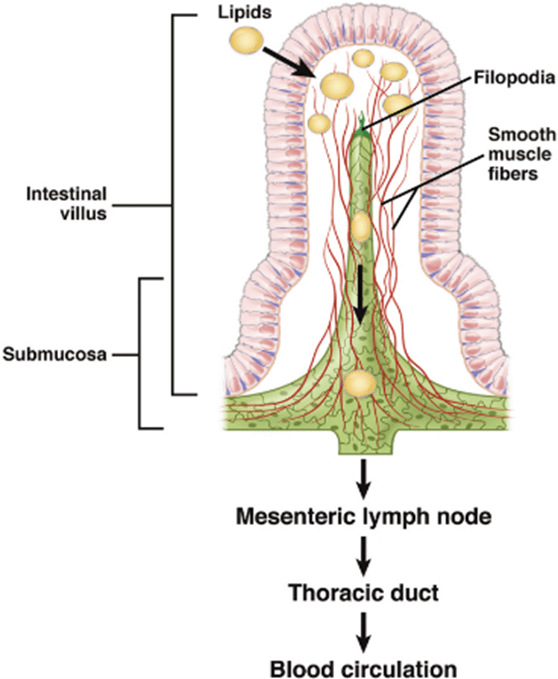
Your small intestine is about 16 feet long, a convoluted tube. It contains millions of finger-like projections, called villi, which increase its surface area and absorptive capacity. Each villus contains one lymphatic capillary, called a lacteal. Lacteals collect fluid and lipids from the interior of the intestines allowing them to be absorbed by the body. The lacteals merge at the base of the villi in the smooth muscle layer into collecting lymphatics – see figure. Smooth muscles perform a cyclical contraction-relaxation “pumping” activity that helps move lymph fluid.
 Gut Lymphatics Diagram – For more information, please see: Cifarelli V, Eichmann A. The Intestinal Lymphatic System: Functions and Metabolic Implications. Cell Mol Gastroenterol Hepatol. 2019; 7(3):503-513. https://doi.org/10.1016/j.jcmgh.2018.12.002 Image reprinted with permission. |
Dietary fats and oils from foods like avocado, salad dressing, nuts, butter etc. are broken down into fatty acids. Chemically speaking, fatty acids are chains of carbons. They can be short (6 carbons or less), medium length (up to 12 carbons), or long (more than 12 carbons). After your food leaves your stomach and enters the small intestines, the short and medium chain fatty acids are absorbed directly from the small intestines into the blood stream.
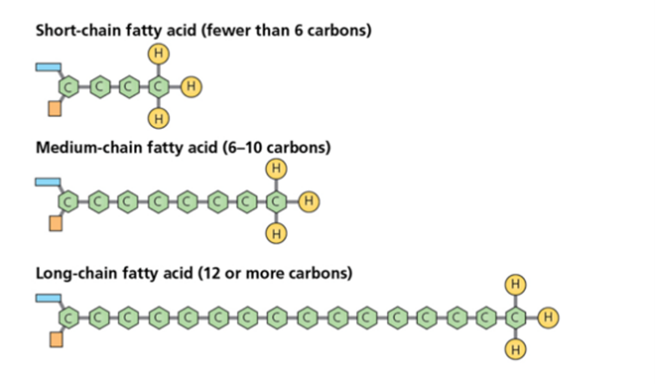 Image credit: https://thewaitingroom.karger.com/tell-me-about/what-are-long-chain-fatty-acid-oxidation-disorders/ |
Long chain fatty acids are combined into lipid transporter spheres, called chylomicrons. Chylomicrons are collected in a milky-white liquid called chyle (pronounced “Kyle”). Chyle is transported through the villi into the lacteals, which send it through the central lymphatic system to the thoracic duct of the blood stream, near the collarbone. Once the chylomicrons enter the blood stream, the fats are transported throughout the body.
You can avoid overwhelming your lymphatics with long-chain fatty acids, by reducing your intake of certain oils and fats. Drinking more water and giving your body at least 12 hours of fasting every night can help give your body time to process the chyle, so you wake up with better-controlled lymphedema. Understanding how your lymphatics work may help you to stick to your healthy eating goals.
 Author Jean LaMantia, is a registered dietitian, cancer survivor, and author of three books, including The Complete Lymphedema Management and Nutrition Guide. She talks about the lymphatic system and its interaction with your diet in her Lymphedema Nutrition School, taught online. Her website, JeanLaMantia.com, includes a blog, video seminars, and other educational materials for patients.
This article originally appeared in the September 2022 edition of The Lighthouse Lymphedema Network Newsletter.

 Sharon S. Shepard
Leave a reply to Lympha Basics – Your Invisible, Essential Lymphatic System – Sharon S Shepard Cancel reply