

A Patient’s Experience with Bilateral Breast Cancer and Lymphedema Prevention originally published in the Lighthouse Lymphedema Network newsletter and website in 2020.
“Did a doctor tell you to do this or is it a ‘personal preference’?”
I glared over my mask at the irritated triage nurse. It had taken calls, letters and discussions with supervisors at Kaiser Permanente to get approval for a blood draw from my foot. And now this nurse questioned my sanity. Why would anyone ‘prefer’ to have needles stuck into the top of their foot, rather than have blood drawn from their arms?
I tried to explain lymphedema, how both my arms were affected by breast cancer surgery and are at significant risk for lymphedema if a needle introduces infection or causes bruising. But later I heard her tell someone, “It isn’t debilitating.”
I dread medical visits.
While I’m grateful my tiny breast cancers were discovered and treated early, I didn’t realize the standard removal of six healthy lymph nodes would create such a hassle for me and my subsequent medical providers. I developed lymphedema in my left arm four months after surgery and recognized that old scars from a shattered right wrist could make lymphedema worse. Since then, I’ve had painful blood draws from my feet, blood pressure measured at the ankle, vaccines injected in my thighs, and minor surgeries done without anesthesia.
And the nurse had a point, because up to now, few doctors could diagnose or treat lymphedema. Physical therapists can feel lymphedema, reduce the swelling, and advise patients to avoid trauma or infection in at-risk limbs. But most at-risk patients and their doctors and nurses understand little about preventing or treating lymphedema. Hopefully, this situation is about to change.
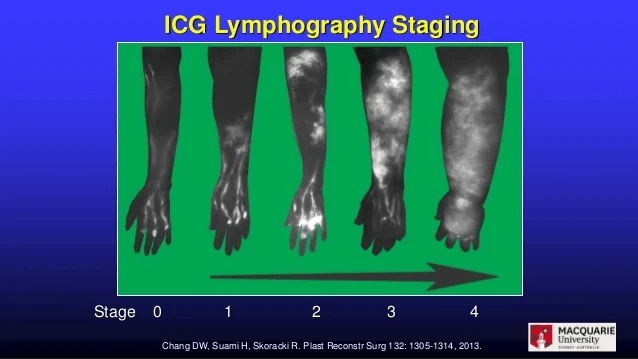
The 2020 Lighthouse Lymphedema Network Conference brought life-changing news. A new tracing agent, Indocyanine or “Spy Agent” Green was approved by the US FDA in November 2018, for mapping the lymphatic system. ICG shows up fluorescent green on an infrared camera and binds to lymphatic proteins. Its wavelength lights up the lymphatic system exclusively, so ICG lymphography can illustrate lymphedema in its earliest stages and pinpoint locations where damage is blocking lymphatic flow. Lymphedema patients and therapists will soon have definitive proof of this condition, and better ways to treat it.
ICG Lymphography can be used to study lymphedema and improve prevention protocols. For example, a study in 2015 (Ferguson et al.) seemed to show that lymphedema was only brought on by obesity or infection – not trauma or airplane travel. A closer examination of Ferguson, though, shows that their definition of lymphedema eliminated patients with stage 0 or 1 conditions, like mine. Only lymphedema advanced enough to be measured with a tape measure counted. This study had additional issues, but its results influenced many medical providers who now question every lymphedema prevention protocol. A challenge to Ferguson using ICG Lymphography might be a game-changer – giving every at-risk patient and medical provider clear proof of the existence of early-stage lymphedema and the body’s response to infection and trauma.
ICG Lymphography has also improved the accuracy of microsurgery to repair damaged lymphatic systems, improving flow for some patients and curing lymphedema in others. Dr. Wei Chen at The Cleveland Clinic is a leader in this field.
I look forward to improvements in the understanding, prevention, and treatment of lymphedema for all patients. Meanwhile, I hope to have my upper body lymphatics mapped before my next blood draw, so I’ll have better answers for the triage nurse.
Thank you to Dr. Chen and the Lighthouse Lymphedema Network for sharing this good news. Now to act upon it, share our stories, and expand research and access for other patients.
Update from 2023 – I’m still trying to find access to ICG Lymphography in the United States.
A Patient’s Experience with Bilateral Breast Cancer and Lymphedema Prevention originally published in the Lighthouse Lymphedema Network newsletter and website in 2020.
 Sharon S. Shepard
Leave a comment